
AGRICULTURE · INVESTMENT · NIGERIA
By DiazHub Editorial | May 2026 | 14 min read
In a country that once supplied over 60% of the world’s palm oil — and now spends $600 million a year importing it — a new digital platform is quietly closing the gap, one tree at a time. PalmReserve.com is giving Nigerian investors the chance to own real, productive palm trees for as little as ₦35,000, earn pro-rata dividends from every harvest, and build inflation-proof wealth rooted in the ground itself.
Nigeria has a palm oil problem — but not the kind you might expect. The problem is not that the country lacks the land, the climate, or the agricultural know-how. It is that for decades, the sector has been starved of organised private investment, leaving a yawning gap between what Nigeria produces and what its population of over 220 million people consumes. That gap, according to the Council of Palm Oil Producing Countries (CPOPC), now stands at over one million metric tonnes every year. PalmReserve was built to turn that gap into an opportunity.
Launched as a digital agro-investment platform, PalmReserve connects individual investors directly to productive oil palm estates. Investors buy tree units, are allocated to real planting batches, and receive pro-rata dividends tied to actual harvest cycles — all trackable through a live dashboard. The pitch is simple and powerful: own a real asset, earn real income, and contribute to Nigeria’s agricultural revival.
| ₦35,000 Entry price per tree | ~₦5.3M Estimated lifetime return per tree | $600M Nigeria spends annually on palm oil imports |
1. What Is PalmReserve?
PalmReserve.com is a Nigerian agricultural investment platform that allows individuals to purchase units in oil palm trees planted and managed on active estates. Rather than investing in an abstract fund or a speculative token, investors on PalmReserve own a defined share of a physical asset — the tree itself — and receive income proportional to what that tree produces.
The platform offers two distinct investment products. The first is tree investment: investors purchase tree units, which are then allocated to a planting batch on an active estate. Investors receive dividends calculated on a pro-rata basis — the more trees you own, the larger your share of every harvest payout. The second product is land plot ownership, where investors purchase specific, documented estate plots with a physical location, block reference, and a digitally issued certificate of ownership.
Both products are tracked through a live investor dashboard that surfaces trees purchased, batch allocations, production reports, wallet balance, dividend history, and official documents — all in one place. The emphasis on transparency and traceability is a deliberate architectural choice: PalmReserve’s stated design principle is that every naira invested should be traceable from purchase to profit.
| “Every naira invested maps to physical palm trees or land — not abstract tokens or paper promises.” — PalmReserve.com — Platform Core Principle |
2. The Market Opportunity: Nigeria’s Palm Oil Paradox
In the 1960s, Nigeria was the undisputed global leader in palm oil, controlling more than 60% of the world market. Palm trees financed education, infrastructure, and early industrial ventures across the Southeast and Southwest. Then crude oil happened. Petroleum captured government attention, investment, and policy focus, while oil palm plantations fell into neglect and Southeast Asian nations quietly built the infrastructure that would eventually dominate global supply.
Today, Nigeria ranks fifth in global palm oil production. Indonesia leads with approximately 50 million metric tonnes annually; Malaysia follows with 19 million. Nigeria produces just 1.57 million metric tonnes — a figure that, despite growing 12% in 2025, remains catastrophically below domestic demand. The country now consumes an estimated 2.61 million metric tonnes per year, creating a structural supply gap of over one million metric tonnes filled exclusively by expensive imports.
| 1.57M Metric tonnes of palm oil Nigeria produced in 2025 — up 12% from 2024 | 2.61M Metric tonnes Nigeria consumed — a gap of over 1 million tonnes |
| ₦2.38M Price per metric tonne in Nigeria as of 2025, up from ₦1.17M in 2022 | ₦7.5M NIFOR’s forecast price per metric tonne by 2030 |
The National Palm Produce Association of Nigeria (NPPAN) has calculated that this import dependency costs the country $600 million in foreign exchange every single year. The Federal Ministry of Agriculture has publicly described the gap as “exporting opportunities and importing what we have the capacity to produce.” And NIFOR has attributed the crisis directly to ageing plantations and a chronic failure to deploy improved, high-yield seedlings at scale. That is precisely where PalmReserve and its Supergene Hybrid model enter the story.
3. The Supergene Hybrid Advantage
Not all palm trees are equal. The variety of oil palm planted has an enormous bearing on how quickly it produces, how much oil it yields, and how long it remains commercially productive. PalmReserve uses the Supergene Hybrid — a Malaysian-origin variety that represents the current peak of commercial oil palm genetics, and the variety credited with making Malaysia the world’s second-largest palm oil producer.
| Early Maturity Supergene Hybrid begins fruiting within 2–3 years of transplanting, compared to 4–5 years for standard Tenera varieties. | Superior Yield Produces up to 90 litres of crude palm oil per tree per year at maturity — 100–200% more than local Nigerian open-pollinated varieties. |
| More Bunches Produces 20–26 fruit bunches per tree per year, compared to significantly fewer with older varieties. Bunches are larger and denser. | Longer Productive Life A well-managed Supergene plantation remains commercially productive for 25–40 years, providing multi-decade income from a single purchase. |
| Premium Oil Quality Produces oil with a superior Free Fatty Acid profile, commanding premium prices from food, cosmetics, and pharmaceutical buyers. | Disease Resistance Broader genetic base confers stronger resistance to fungal disease, reducing crop loss risk for investors. |
4. The Return Potential: Doing the Maths
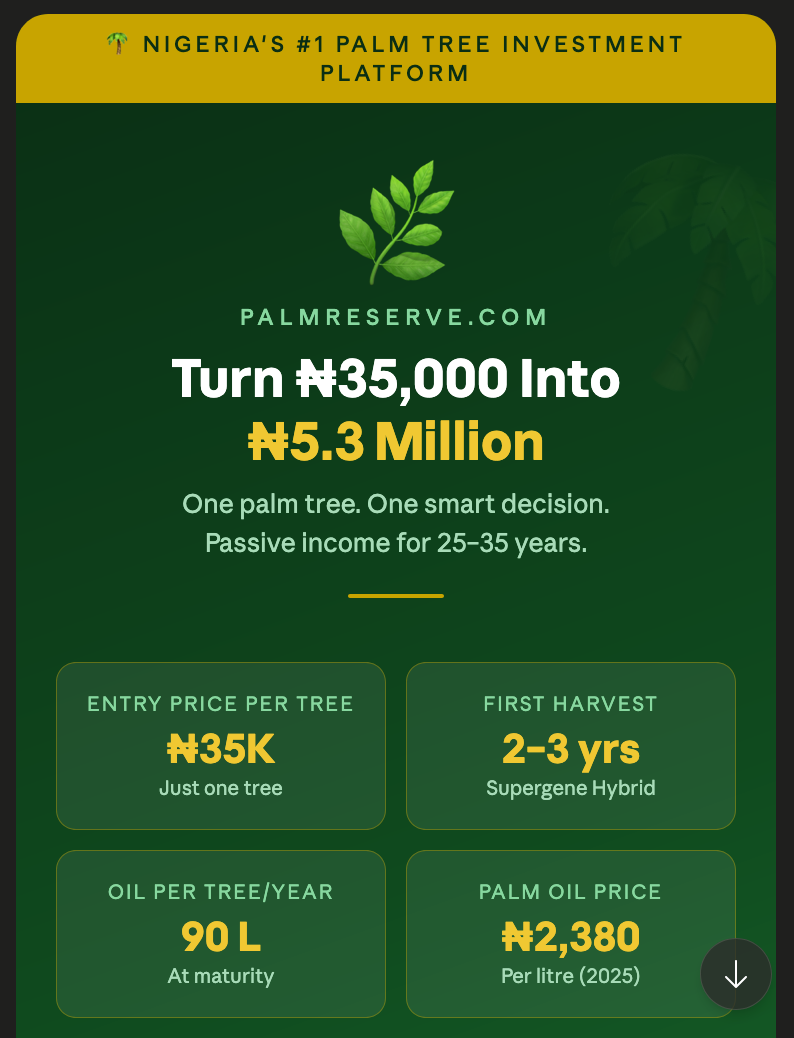
At full maturity, a Supergene Hybrid tree produces approximately 90 litres of crude palm oil per year. According to NIFOR’s 2025 research data, the average price of palm oil in Nigeria currently stands at ₦2.38 million per metric tonne — approximately ₦2,380 per litre.
At those figures: 90 litres × ₦2,380 per litre = ₦214,200 in gross revenue per tree, per year. Even after accounting for management, harvesting, and processing costs — which typically absorb 20–35% of gross revenue on a well-run managed estate — an investor can expect net earnings of ₦140,000–₦175,000 per tree annually once the plantation reaches full production.
Against an entry price of ₦35,000 per tree, the gross payback period from harvest income alone is less than six months at full production. Over a 25-year productive life, a single tree purchased today at ₦35,000 projects to generate approximately ₦5,355,000 in lifetime revenue — a 15,000% return on the original investment.
| “Palm oil prices rose more than 100% between 2022 and 2025, and NIFOR forecasts the commodity could reach ₦7.5 million per tonne by 2030. The trees investors plant today will be producing during that window.” — Based on NIFOR Research Data, 2025 |
The Compounding Effect of Scale
Because tree units are priced individually, investors can start small and accumulate additional units over time, growing their share of each harvest batch proportionally. An investor who acquires 50 trees (₦1.75 million investment) stands to generate over ₦10 million in annual gross revenue at maturity. One hundred trees could yield over ₦21 million per year from a single asset class.
Crucially, this income is not a one-time event. Unlike real estate sales or stock capital gains, harvest dividends from productive palm trees recur year after year, for as long as the trees remain productive — which, for Supergene Hybrid, is measured in decades, not years.
5. How the Platform Works: Step by Step
PalmReserve has been designed for accessibility — the process from account creation to confirmed tree ownership takes minutes, not weeks. Here is how the investment journey unfolds.
| 01 | Create Your Account Register at PalmReserve.com. The onboarding process is fully digital — no physical paperwork or branch visits required. Your investor dashboard is created immediately upon registration. |
| 02 | Choose Your Asset Select tree units, land plots, or both — based on your budget and investment goals. The Returns Simulator allows you to model projected earnings before committing any capital. |
| 03 | Complete Payment Pay via bank transfer. Upon confirmation, you receive a reference number and your dashboard updates to reflect your new holdings. Digital receipts and certificates are issued and stored in your account. |
| 04 | Batch Allocation Your purchased trees are assigned to a planting batch on an active estate. You own a pro-rata share of that batch’s total production. Your dashboard reflects each stage in real time. |
| 05 | Earn Dividends Once production begins, dividends are calculated as: Trees Owned × Declared Profit Per Tree. Payouts are credited to your PalmReserve wallet with a full ledger history. You can withdraw or reinvest. |
6. Transparency and Traceability
One of the most common criticisms levelled at Nigerian agricultural investment schemes is opacity. PalmReserve’s architecture is explicitly designed as an answer to that problem. The platform’s “Plantation Intelligence” module provides live operational metrics: trees sold, trees awaiting planting, trees actively growing, productive trees generating revenue, and units pending batch deployment — all visible to every user in real time.
The dividend formula — Trees Owned × Declared Profit Per Tree — is published openly on the platform. There is no black box, no proprietary calculation model, and no administrative discretion in the payout. If the batch produces, you earn. The amount is determined entirely by how many trees you own and what the batch declares as profit per tree, which is itself derived from actual production revenue.
7. Why Now? The Tailwinds Behind Palm Tree Investment
The Global Supply Squeeze
Indonesia and Malaysia, which together account for roughly 85% of global palm oil supply, are pivoting significant portions of their output toward domestic biodiesel mandates. Indonesia has set a B50 biodiesel mandate for July 2026, meaning half of its palm oil production will be diverted to fuel. This structural redirection is tightening global availability and pushing prices upward. Nigerian domestic producers, insulated from this supply-side shock, stand to benefit directly.
Relentless Domestic Demand Growth
Nigeria’s domestic palm oil consumption has risen from 2.45 million metric tonnes in 2020 to 2.61 million metric tonnes in 2025, and it continues to grow as urbanisation accelerates. Palm oil is not a luxury — it is embedded in daily life as a cooking ingredient, a cosmetic base, a pharmaceutical excipient, and an industrial feedstock. Companies like PZ Cussons, Unilever, and May & Baker depend on it. Demand does not fall when the economy slows.
Price Inflation That Rewards Early Movers
NIFOR’s research shows that palm oil prices have risen from ₦1.17 million per tonne in 2022 to ₦2.38 million per tonne in 2025 — a more than 100% increase in just three years. The institute forecasts prices could reach ₦7.5 million per tonne by 2030. For an investor who plants Supergene Hybrid trees today, those trees will be producing at or near full capacity precisely as the 2030 price window opens.
Government Alignment
For the first time in decades, the Nigerian federal government has publicly identified palm oil as a priority non-oil growth sector. The Federal Ministry of Agriculture has set internal rate of return targets of 18–25% for palm sector investment models and engaged the CPOPC on technical cooperation. This policy direction creates a supportive environment for private platforms like PalmReserve.
8. Who Is PalmReserve For?
PalmReserve’s accessible entry price and digital-first infrastructure make it genuinely inclusive, but its value proposition maps differently depending on the investor profile.
For salaried professionals looking to diversify beyond bank savings and mutual funds, PalmReserve offers a real asset with demonstrable yield potential and a long income horizon. A monthly investment of even ₦35,000 — one tree per month — builds a portfolio that could be generating millions in annual dividends within three to four years.
For diaspora Nigerians seeking exposure to Nigeria’s agricultural growth without the friction of physical land management, PalmReserve’s fully managed model eliminates the operational headache. The investor does not plant, supervise, harvest, or sell — the platform handles all of it, and the investor tracks progress from anywhere in the world.
For high-net-worth individuals seeking portfolio diversification into a tangible, inflation-resistant asset, bulk tree acquisition offers a combination of current-year income from existing productive batches and long-term capital appreciation as both land and palm oil prices trend upward.
And for younger investors just entering the wealth-building journey, the ₦35,000 entry point makes this one of the most accessible hard-asset investments available in Nigeria today — a starting point that compounds naturally as income is reinvested into additional tree units.
9. Considerations Before Investing
No investment is without risk, and PalmReserve is transparent about this: the platform’s own footer notes that “agricultural investment returns are subject to production performance, and past yields do not guarantee future results.”
Agricultural commodities are subject to weather events, disease pressure, and global price fluctuations. While Supergene Hybrid has strong disease resistance, and Nigeria’s climate is highly favourable for oil palm, no crop is entirely immune to natural variation. Investors should treat projected return figures as estimates based on current data, not guaranteed outcomes.
Palm tree investment is also inherently patient capital. Although Supergene Hybrid matures faster than older varieties, the first harvest typically arrives two to three years after planting. Investors seeking short-term liquidity should structure their portfolio accordingly.
Prospective investors are encouraged to conduct independent due diligence, verify the platform’s operational metrics through its live dashboard, and start with a position sized appropriately for their overall financial situation before scaling up.
10. The Verdict
PalmReserve.com arrives at an extraordinary intersection of national need and individual opportunity. Nigeria is a country that was once the world’s palm oil capital, that possesses the climate and land to be so again, and that currently imports more than a million metric tonnes of a commodity it could produce itself. Every tree planted through PalmReserve is simultaneously a personal investment decision and a small act of national reclamation.
The platform’s model is structurally sound: real assets, transparent mechanics, live traceability, and a dividend formula that is simple enough to verify in seconds. The underlying commodity has strong and growing demand, a rising price trajectory confirmed by official research, and a global supply environment that increasingly favours domestic African producers.
At ₦35,000 per tree, the entry point is the lowest barrier to hard-asset investing available in the Nigerian market today. For investors willing to think in decades rather than quarters, PalmReserve represents one of the most compelling propositions in Nigerian agriculture right now — a chance to plant not just a tree, but a legacy.
| Ready to Plant Your First Tree? Explore the platform, run your return projections on the simulator, and start building your palm portfolio today. Visit PalmReserve.com |
KEY INVESTMENT FIGURES
| Price per tree | ₦35,000 |
| First harvest | 2–3 years |
| Oil per tree per year | 90 litres |
| Palm oil price (2025) | ₦2,380 per litre |
| Gross revenue per tree/year | ~₦214,200 |
| Productive lifespan | 25–40 years |
| Estimated lifetime return | ~₦5,355,000 |
NIGERIA PALM OIL MARKET
| 2025 production | 1.57 million MT |
| 2025 consumption | 2.61 million MT |
| Annual supply gap | >1 million MT |
| Annual import cost | $600 million |
| Price rise 2022–2025 | +103% |
| NIFOR 2030 price forecast | ₦7.5 million per MT |
DISCLAIMER
This article is for informational purposes only and does not constitute financial or investment advice. All return projections are estimates based on publicly available market data from NIFOR, CPOPC, Nairametrics, BusinessDay, and other cited sources. Agricultural investment returns are subject to production performance and market conditions. Readers should conduct independent due diligence before making any investment decision. DiazHub is not affiliated with PalmReserve.com.